Across all time and in every culture, persons of power have traveled to alternate realities on the vibrations of a journey drum.

Thursday, July 16, 2015

Cougar spirit shaman drum


I’ve just finished painting this new native style frame drum with a spruce wood hoop and blacktail deer hide. The hoop is 12" in diameter but the voice is deep and strong.  A perfect drum to play outside because the smaller drum head size will not easily slacken in humidity or warp in heat.


This drum was first called "rain" because spirits always come in the rain, and our drought here in British Columbia was ended (briefly) with two days of rain just before I painted this great cat touching a pool of rainwater.  It has been so dry and the fire danger extreme, and I kept wondering, "What do the animals do?  How do they find water to survive?" 


The painting itself was inspired in the brief moment I drew a faint black line across the light area in the drum head which at first I thought was entirely the cat’s paw.  Suddenly the lower half of the shape became a reflection, and the faint squiggles in the deer skin’s surface resolved themselves into lines in rock and edges formed by water. 


The cedar ring is fitted with an interlacement pattern of the 7-pointed Mystic Star, which is considered effective protection against evil influences and rival magicians.
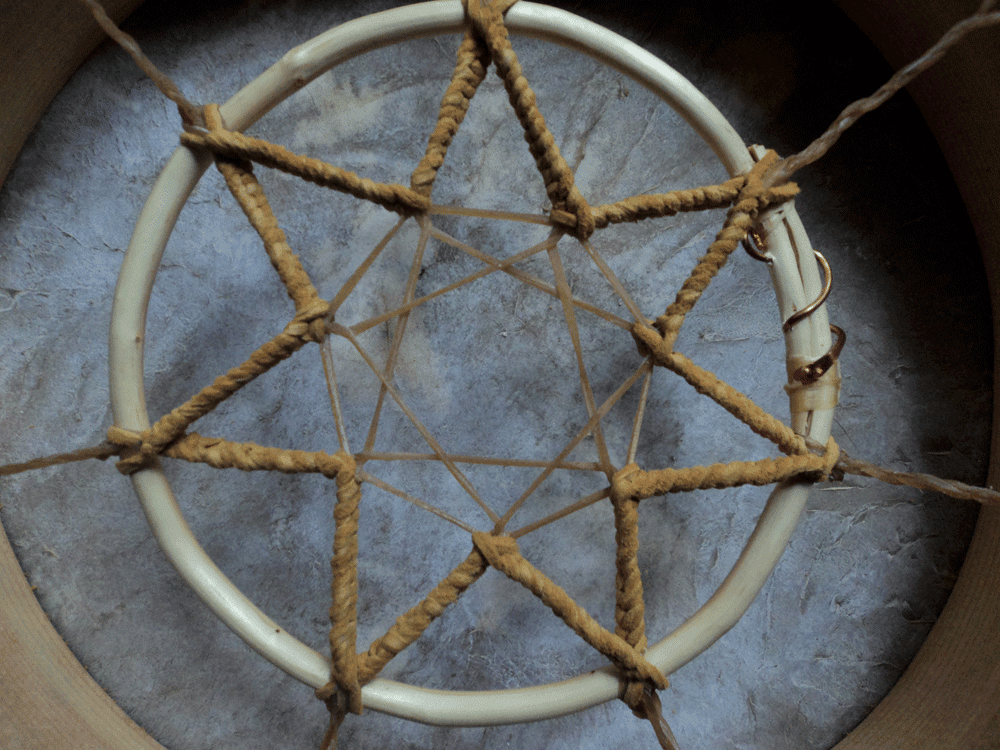

The star design is repeated twice, with the outer pattern wrapped in a decorative hitching of sailor’s knotwork made of doeskin.   In the Tarot, 14 is the number of Temperance—the quality of being moderate; to restrain from extremes. 


Perhaps the life-saving rain came in that world as well as this world, and the spirit of cougar is showing me that for this moment, the extreme has been moderated and all is well. 


For more information about this drum please visit my web store

Thursday, June 25, 2015

New Shamanic frame drum from Journey Oracle


This native style frame drum is hand made with a spruce wood hoop and blacktail deer hide.


The cedar ring is fitted with an interlacement pattern of the 7-pointed Mystic Star, which is considered effective protection against evil influences and rival magicians. 


Numerous mystic sevens include the seven planetary spirits, seven deadly sins, seven churches of Asia, seven sacraments, seven days of creation, seven ages of man, seven pillars of wisdom, seven liberal arts, seven virtues, seven wonders of the world. 


The star design is repeated twice, with the outer pattern wrapped in decorative sailor’s knotwork of doeskin.


This drum is called “Little Brother” because it was taken from a deerskin that provided a second larger drum head.  It is very unusual for such a thin skin from a young deer to contain two drums.  To read more about my shamanic drums go to www.journeyoracle.com.  To purchase Little Brother go to my web store.   The larger drum that I call “Big Sister” is being finished and will also be available for purchase soon.


LITTLE BROTHER

12" spruce wood frame
Blacktail deer skin
cedar ring with Mystic Star interlacement pattern
wrapped in decorative knot work of doeskin

$250.00  (Can) unpainted 
shipping additional 

Monday, June 1, 2015

Repair your frame drum

I have been making frame drums for more than 30 years, and I sometimes repair splits in the dried skin where it passes over the drum rim. Here is a photo essay showing the techniques I use.


This drum has had the larger splits stabilized using small headed furniture tacks, and holes burned into the leading edge of smaller tears to stop their progress.


I assemble a needle nose pliers, a small hammer and nickel plated furniture tacks.


And also a wire cutter and small pair of vice grips.  I shorten the shank of each tack by almost 1/2 so I am not trying to pound its full length into the drum rim.  


The tack is then re-sharpened using a small taper file, again by holding it with the vice grips 
against a firm surface.  


The needle nosed pliers make it possible to grip the tack and keep it steadily positioned on the drum rim to one side of the tear.


Both sides of each larger split are anchored with tacks driven straight down into the center of the drum rim.  Takes a bit of courage to begin!


For smaller splits that have a clear leading edge, I use a large bodkin, or yarn needle, to burn a hole just where the tear ends. I am sure to mark the precise location with a pencil before heating the needle with a propane torch, because when the tip is red hot is not the time to go searching for the target. 


While not every split is capable of being stabilized using these two techniques, hopefully the overall effect will give the drum more years of being a voice for spirit. 


It is interesting to notice that most tears cluster on one side of a drum, as shown here by the position of the tacks.  This hoop is very strong, so when the uneven tension in the skin had to find release, it did so cracking itself, rather than by deforming the hoop.  

Friday, March 20, 2015

Drum images come alive


The paintings on my drums come from gazing into the newly dried hide and seeing forms appear in the mottled surface.  When I make a shamanic rattle, it is as if the drum images come alive in the three dimensional forms of dried skin.


The basic form is made by sewing wet rawhide into a shape, and then packing the interior with wet, clean, coarse-grained sand.  The rawhide shape is allowed to dry for several days until the sand can be knocked out, leaving a hard hollow form.


This Fancy Dancer is made of such complex twists and turns that its not really possible to understand  its overall form, which seems to match my experience of watching the fancy dancers at tribal pow wows.  In the rattle all the color and detail is on the inside, made of the seeds, stones and other sacred objects filling the rawhide shells.


Sometimes the shaman rattle takes a shape that was not planned or intended.  It just happens in the curls of leftover hide scraps from making a drum, and suddenly, an Octopus spirit is born.


This rattle of Eagle spirit had a powerful beginning story.  We live on a northern island, known for its wild places and eagles.  Many years ago, when I first moved to Cortes, I asked at the beginning of a canoe trip, "May I please be honored to find an eagle feather."  Someone had given me the breast bone of a large bird and I understood that if I received an eagle feather this would confirm that the bone was from an eagle.  The 28 feathers that I found on that weekend became this shamanic rattle, used for eating from the body energy that is out of phase.


Sometimes a drum fails--the wood warps or the hide develops cracks.  When this happens the image comes alive as neither a drum nor a rattle.  This drum face was cut away from a twisted frame and became a dimensional painting of birth: the beaded blood lines becoming black headed sperm seeds swimming through turkey feathers to contact the egg that will be the mother and child.  

I understand that everything is alive, and yearning to find its true form.  As an artist, one of my best skills is to let the form itself say how it wants to come alive. 

Now that I am returned from holiday, and the 2nd edition of the Journey Oracle divination deck is ready to pick up from the printer--I will be focusing on creating an online oracle reading. 

Friday, January 9, 2015

The Oracle shamanic frame drum


This new drum from the Journey Oracle has a story of unexpected shifts and changes of direction.  When it was first drying I noticed the frame had a slight “lift” on two sides which is a technical disappointment to me because it means that I put too much tension along the backbone when I was making the drum.  This does not affect the sound of the drum, it is rather like a small chip in an otherwise beautiful carving.  But when the drum was fully dried, the lift, which usually gets worse instead of better, was almost entirely gone.


The cedar ring holding the back of the drum started out round, 


but as the drum dried it became more egg shaped, which caused the 9 pointed Star of the Muse interlacement pattern to “move” as if flowing to the right, instead of stay stationary in the center of the circle.


The original name of this drum was Smoke and Hope, because just as I was beginning the painting Master and Commander was on TV in the background, and I heard Russell Crowe tell his First Mate to “run like smoke and hope” to escape the pursuing French ship.  I was looking at the drum and suddenly saw the lighter areas as smoke. 


And then I saw the figure.  


And her hand appeared.


And I knew this was an Oracle.  Her expression is too mysterious for me to decipher.  Just as in the making of this drum, the understanding of who is speaking shifts and flows like the fire.

THE ORACLE DRUM

Blacktail deer hide, Spruce and Cedar wood
smoke-tanned leather hitching, raw earth pigments
14"

$350.00
shipping additional

For more information contact Kristen at journeyoracle@gmail.com

See more of Kristen's drums, drumsticks, shamanic paintings 
and the Journey Oracle cards and book go to 
www.journeyoracle.com

 Listen to this drum being played with a felt covered drum stick by clicking on this link:

Monday, December 29, 2014

Using sailor's ropework to decorate a drumstick

This post continues my story of how I felt, wrap and finish a drumstick for my shamanic frame drums.  After the wool felt sleeve is dry I secure it with a band of plant-based glue  in preparation for the next step, which involves a circle of smoke-tanned leather and a pair of very sharp scissors.


The leather needs to be cleaned and well finished on both sides.  Any fiber or irregularities left on the skin will cause the thong to have weak sections, and I will need a length of leather that is thin yet even in thickness and sturdiness.


I cut 10 feet of  thong to cover 5 inches of drumstick.  I learned these calculations from my favorite book of ropework projects:  Des Pawson's Knot Craft.  I am going to use St. Mary's hitching to cover the center section of this drumstick, so I also cut a second thong of 5 feet. 


I begin with a constrictor knot in the middle of the long piece of thong that will also hold the end of the shorter piece of thong in place. 


There are now three lengths of thong on the right side of the stick.  St. Mary's hitching is made by always making the hitch from the top strand, with all hitches going in the same direction.  As I wrap I keep the hitches tight and each strand of leather snug against the previous ones so the resulting pattern is without loose places or gaps. 


I think St. Mary's hitching is the more unusual looking of the two patterns I use: hard to figure out how its done and yet easy to create.  I like that combination.


Moku hitching is made by dividing one thong into two equal lengths, beginning with a constrictor knot, and then hitching alternate strands in opposite directions. 


I'll conclude this photo album another time with a description of how I finish the handle of the drumstick.  You can see these and other drumstick styles by going to the Journey Oracle website or my webstore on Etsy.  

Saturday, November 29, 2014

Making a felted drumstick


This photo album will show how I make a felted drumstick for my shamanic frame drums. Unwashed wool that has lots of lanolin works best.  This wool is from the Falkland Islands and some of the best I have used.  Maybe it is because the sheep protect themselves from the cold with lots of oil.


 First I card the wool and peel off each section, setting these aside until I have 6-7 lengths with which to form the head.


Next the wool sections are laid over a hardwood dowel that has its ends rounded and is sanded along its length,  At this stage everything looks quite fragile.


As more and more pieces of wool are added and the wool is pressed with my hands, the shape begins to resemble a drumstick, but of something I would like for a special dinner.


Once the wool is shaped, and I can feel that the thickness on the tip and sides is about the same density, I gather a boiling kettle of water, a stone, dish soap, and the drumstick on a old broiler pan.


This is the scary part!.  It seems that all my hard work to shape the wool has disappeared into soap and water. In fact, this is the scary part.  If the wool wraps around itself and folds over, it will felt to itself instead of into the shape I want--making creases and lines in the finished felt.


As soon as I can tolerate the heat, I use my fingers instead of the stone to push the wool into the stick. The hot water causes the wool to shrink, and the liquid soap causes the fibres to slip past each other.


At some point I cut off the bottom length of wool that stretches down the stick as I squeeze.


A nice shape begins to emerge in the soapy hot water.  Getting to this stage takes me about 1 hour and one full kettle of water. 


The last step is rinsing out the soap with cold water and lots of squeezing, not twisting.  As the soap leaves the felt becomes more and more compressed and tightly fitted to the stick.  


The felt and the stick dry for about two days before I use a felting needle to tighten the fibre even more.  I'll make another photo album of how I use leather and sailor's knot patterns to wrap and decorate the center section of the drumstick.